

What is an e-consult?
An e-consult is an asynchronous dialogue initiated by a physician or other qualified health care professional seeking a specialist consultant’s expert opinion without a face-to-face patient encounter with the consultant.
Patient and Provider Experiences
Alyssa Spencer, PA, Wellspace Health, presents her patient’s story and how E-Consult improved her care experience.
...up to one-third of referrals to specialists could be resolved with “e-consults” without an additional appointment. All of this is possible with the right payment system that rewards doctors for providing the level of care that patients need, not what insurance will pay for.
Michael L. Barnett, MD, assistant professor of health policy and management at the Harvard T.H. Chan School of Public Health and primary care physician at Brigham and Women’s Hospital.
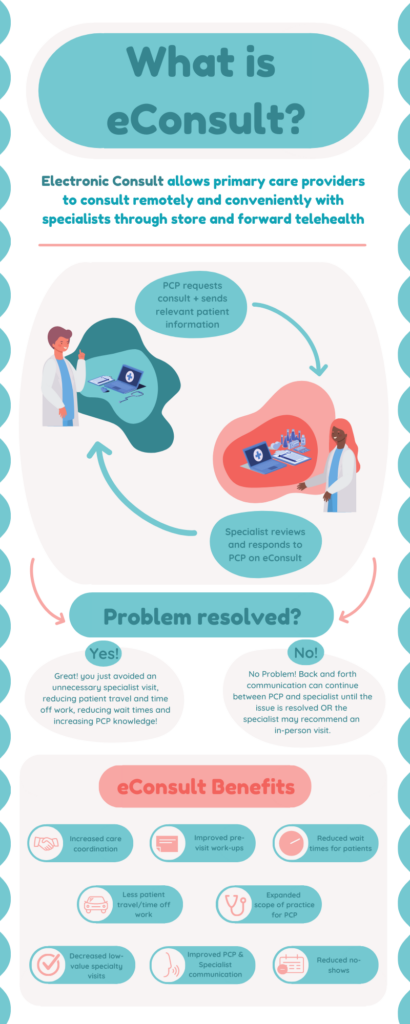
E-Consult Programs Deliver Efficiency, Cost Savings and Satisfaction
Efficiency
Specialist response times improve ranging from half a day to three business days.
Patients with e-consults are scheduled for face-to-face visits more quickly. Wait times for patients with eConsults range from 5 to 34 days, compared to 65+ days without…an average of 89.2% reduction in specialty care wait times.
Cost Savings
Unnecessary face-to-face visits are reduced. e-consult programs have resulted in a 54.6% reduction of inappropriate referrals. An average of 69.2% of e-consult questions are resolved virtually.
No show rates are reduced. Visit completion rates following e-consult range from 64-88% as compared to 60-70% with traditional referrals.
Satisfaction
PCP satisfaction is high with 70-100% of primary care providers expressing satisfaction with e-consult advice and patient care. Specialist satisfaction is high with 50-95% of specialists satisfied with e-consult use. Patient/member satisfaction is high with 78-96% of patients satisfied with e-consult quality, access, and safety.
Why e-consult?
Access to specialty care is a major challenge for patients across the country. With provider shortages, demand outpaces the ability to meet the needs of a growing patient population, resulting in unmanageable wait times. Payers and provider organizations have realized that up to 50% of their patients’ non-urgent needs can be addressed without a face-to-face visit, reducing travel time and cost. With this, health systems, payers and policy makers are turning to e-consult.
A safety net system can’t afford to hire enough specialists to meet demand — e-consults get around that problem by increasing access through enhancing efficiency.
Dr. Mitchell Katz, former director of the San Francisco Department of Public Health. He is now the president of NYC Health & Hospitals, the nation’s largest public health care network, and he wants to expand the use of eConsults there as well.